
WE GATHER TOGETHER
1789: The First Jewish American Thanksgiving

This Thanksgiving Day, November 27th, will mark the 234th time that congregants of Shearith Israel, the Spanish and Portuguese Synagogue in New York City, conducts a Hallel (“Praise” in Hebrew) Thanksgiving Day service. For the occasion the knobs of the Torah scroll will be adorned with Liberty Bell rimonim (filials). After the service hot chocolate will be served and members and their children will be invited to watch the Macy’s parade from the Tiffany glass-stained windows of the synagogue that has been located on the parade’s route on New York’s upper west side since 1897. In the afternoon members will be invited to participate in a “Packathon” to help deliver farm fresh food to a nearby Masbia soup kitchen, the latest version of their synagogue’s way of giving back to the community.
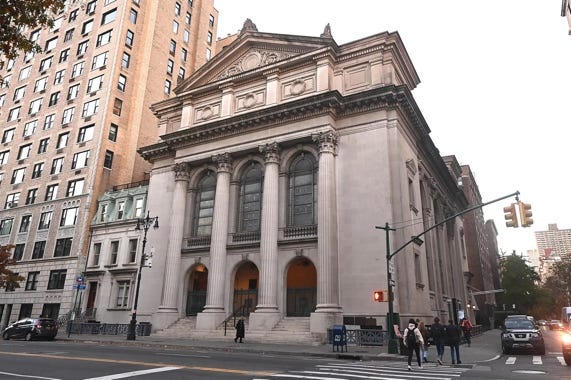
The Shearith Israel Thanksgiving service had its beginnings the same year that George Washington declared a national holiday of Thanksgiving in 1789, almost two hundred years after the Dutch Puritan Pilgrims and the Wampanoag Native Americans sat down to their first meal together in Plymouth, Massachusetts in 1621.
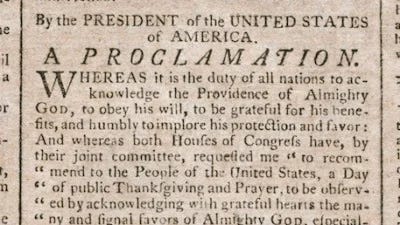
President George Washington proclaimed Thursday November 26, 1789, as a day of national thanksgiving to God
---”for His kind care and protection of the people of this country previous to their becoming a nation.
---for the signal and manifold mercies, and the favorable interpositions of
His providence in the course and conclusion of the late war.
---for the great degree of tranquility, union, and plenty which we have since enjoyed.
---for the peaceable and rational manner in which we have been enabled to establish constitutions of government for our safety and happiness, and particularly the national one now lately instituted.
---for the civil and religious liberty with which we are blessed, and the means we have of acquiring and diffusing useful knowledge.
---and, in general, for all the great and various favors which He has been pleased to confer upon us.”
He then called for citizens “to gather in houses of worship to offer prayers of gratitude for the blessings of independence as well as petition for divine guidance and blessing for the new nation.”
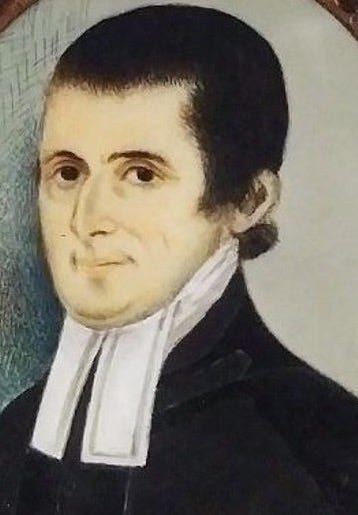
In response to Washington’s wishes, Gershom Mendes Seixas, the leader of the Shearith Israel congregation in New York City, organized and conducted the congregation’s first Thanksgiving Day of Prayer. Shearith Israel, the oldest Jewish American congregation, had begun in 1654 shortly after twenty-three Sephardic Jews had first arrived in New York with the hope of escaping religious persecution that had begun during the Spanish Inquisition of 1492 and had forced them to seek safer ground in places like Holland, the West Indies and Brazil. When those countries began to become more threatening, they set their eyes on America. Quickly they became successful businessmen while continuing to hold on to their religious traditions.
At the time of Washington’s declaration, Jews in America numbered approximately 2,000, less than one tenth of one percent of the American population. A large number of the early congregants of Shearith Israel served in the Continental Army that helped bring about American independence. When the war ended, the congregants were grateful that the country they had defended allowed them to worship freely and to become full citizens for the first time since Biblical days.
Shearith Israel’s descendants were Sephardic (derives from the Hebrew word for Spain). Unlike the German Jews (Ashkenazic Jews) who soon followed the Portuguese and Spanish Jews to America, Sephardic Jews relied on the Babylonian version of the Bible rather than the Jerusalem version and they were more influenced by their history of having lived in a Christian and Muslim culture. Their native language was Ladino, a combination of Hebrew, Spanish, and Arabic.
Gershom Mendes Sexias was an ardent Jew who was one of the first Jewish leaders to be born and educated in the US. He came from a wealthy Sephardic family of merchants and bankers but had chosen instead to pursue a spiritual path for “his people.” He started out as Shearith Israel’s leader before the war in 1768 and then moved to Philadelphia rather than live under British rule during the war. After the war was over, he returned to New York City and once more assumed his role as spiritual leader (Hazan in Hebrew) of the congregation.
The Thanksgiving service Seixas invoked was essentially a message of gratitude for the blessing of living in America.
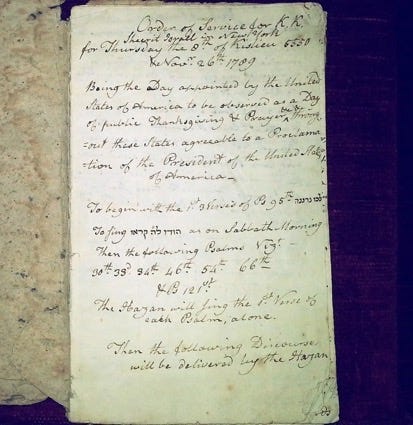
Among the features of the service were:
----The chanting of several Biblical psalms of thanks….
Not unto us, O LORD, not unto us, but unto thy name give glory, for thy mercy, and for thy truth’s sake…. Psalm 115
----A prayer for the United States government….
Bless, preserve, guard, assist, and supremely exalt to the highest degree, the President and Vice-President of the Union, the Senate and House of Representatives of the United States of America, the Governor, the Lieutenant Governor, the People of this State represented in Senate and Assembly, with the Judges and Magistrates of this city
----And a sermon or “discourse….” where Gershom Mendes Seixas compared the Americans’ struggle for independence to the Jewish exodus from Egypt. In both situations those who were freed were asked by the Almighty to render thanks for their good fortune and, in return, do good deeds, maintain a cheerful manner of supporting the government, and serve the public good.
“As Jews,” he said, “we are even more than others, called upon to return thanks to God for placing us in such a country – where we are free to act according to the dictates of conscience, and where no exception is taken from following the principles of our religion.”
Thus began the traditional Hallel service that has continued to this day except for the years 1849 and 1854 when the New York governors at the time declared Thanksgiving to be a Christian holiday rather than an American holiday. Only a few changes to the service have been made through the years, most notably the addition in 1945 after World War II of a reference to the establishment of the State of Israel.
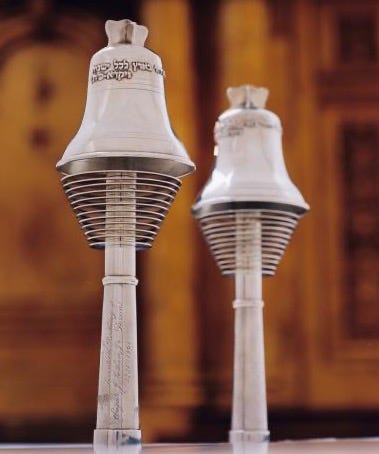
Although the Shearith Israel congregation defines its Jewish identity as Orthodox, it also welcomes anyone who is interested in the Jewish religion and spirituality, Jewish education and the Jewish community. Distinguished past members of the congregation include Emma Lazarus whose words “Give Me Your Tired, Your Poor” appear at the base of the Statue of Liberty, and Supreme Court Justice Benjamin Cardozo (1914 to 1932).
As we all celebrate (or choose not to celebrate…there are a few among us who protest) our own versions of Thanksgiving….feasting on turkey; watching the Macy’s Day Parade; running a Turkey Trot; helping out at a soup kitchen; or engaging in an endless array of football games on television or in person…Shearith Israel’s interpretation of how to celebrate Thanksgiving is exemplary as a way of conveying gratitude for how Jewish Americans got to where we are today.
SOURCES:
“Patriotic Manhattan Synagogue has celebrated Thanksgiving since 1789.” By Jon Levine. New York Post. November 2021.
“Thanksgiving: The origins, criticism, Jewish view of the holiday explained.” By Aaron Reich. New York Post. November 2022.
“Thanksgiving: The Thanksgiving Proclamation.” Mt.Vernon.org
“Thanksgiving at Shearith Israel.” ShearithIsrael.org
“Thanksgiving: A Jewish Perspective.” By Naftali Silberberg. Chabad.org
“Thoughts for Thanksgiving.” By Rabbi Marc Angel. Institute for Jewish Ideas. Jewishideas.org
“The First American Jew: A Tribute to Golem Mendes Seixas. ‘A Patriot Rabbi of the Revolution.’” American Council for Judaism. May 2007.
“Giving Thanks for the Constitution at New Yor’s Congregation Shearith Israel.” By Gershom Mendes Seixas. November 26, 2789. ReligioninAmerica.org
“What is Jewish About Thanksgiving?” By Rabbi Eric Eisenkramer. ReformJudaism.org
“Hallel.” Jewish Virtual Learning.
“The American Jewish Experience in the 19th century: Immigration and Acculturation.” By Jonathan Sarna and Jonathan Golden. Brandeis University.
“Sephardic Jewish America.” EBSCO.org
“The First Hebrew Thanksgiving in America.” By David Geffen. Jerusalem Post. November 2024.
“The First Thanksgiving Sermon Given by a Rabbi in 1789.” Jewish Daily Forward. 2025.
“Golem Mendes Seixas: A Jewish Leader at the First Thanksgiving.” By Hadara Graubart. Tablet Magazine. November 2009.
“Thanksgiving Thursday.” By Rabbi Gila Colman Ruskin. Ritualwell.org
Thanks for your writings, Mimi. Always enjoy reading them.