
It Ain't Necessarily So
Said the Gershwin Brothers

George and Ira Gershwin created memorable music that continues to remind us of our heritage. In none of their works is that more important than in their 1935 folk opera Porgy and Bess. Though the story is about the plight of African Americans in the turn of the century South, the Gershwins,’ created a work that embraces their roots as first generation Jewish Americans.
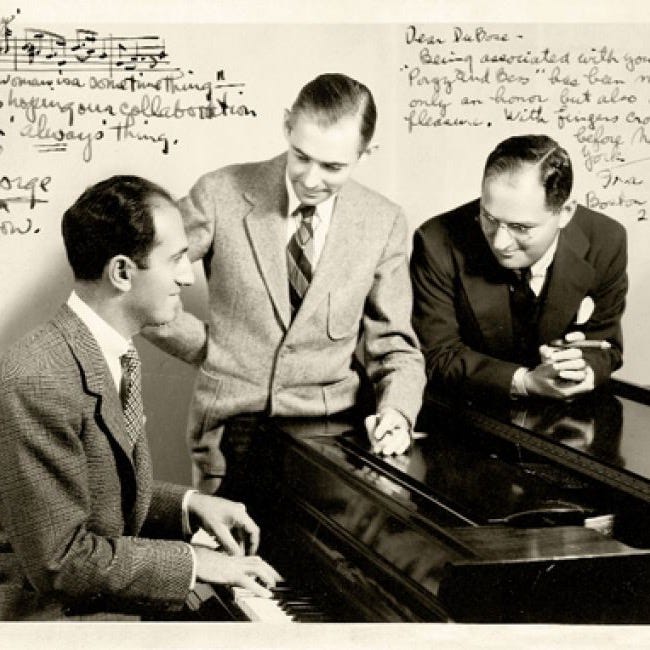
George Gershwin once gave his brother Ira an engraved cigarette lighter that described their relationship: “George the music, Ira the words.”
When the two brothers collaborated on the opera Porgy and Bess in 1935, they were already highly successful creators of popular songs like “Embraceable You” and “I’ve Got Rhythm” and musicals like Lady Be Good, Girl Crazy, and Of Thee I Sing (Pulitzer Prize in 1931). George had also delved into classical music with his piano concerto Rhapsody in Blue as well as other symphonic endeavors.
George and Ira Gershwin (nee Gershowitz) were children of Jewish Russian immigrants who had arrived in America at the beginning of the twentieth century and settled in Brooklyn, New York. They grew up in a secular Jewish home that was more culturally Jewish than religious. Of the four Gershwin sons, only Ira, the oldest, had a bar mitzvah. Most of their Jewish learning came from attending the Yiddish Theater on the Lower East Side in New York City and from meeting the actors from the theater that their parents invited to their homes. (There were several homes).
Both George and Ira were committed Americans but also proud of their ethnic heritage. Before they began to collaborate, Ira wrote a song about friends of his, four Jewish violinists including the virtuoso Jascha Heifitz. The refrain was “We’re not highbrows, We’re not lowbrows, We’re He-brows.”
Once they were famous and courted by society, George began to search around for something a bit more “profound” to write, something that would put him on a higher plateau for his musical contributions. He was quoted as saying “I’d like to write an opera of a melting pot of New York City itself, with its blend of native and immigrant strains. This would allow for many kinds of music, black and white, Eastern and Western, and would call for a style that would achieve out of this diversity ‘an artistic unity.’”
To reach his goals, he first tried to get the rights to compose an opera based on S. Ansky’s The Dybbuk (see my 2024 blog, “The Dybbuk”), a Jewish story about the supernatural, but someone else was able to attain the rights and he needed to look elsewhere.
In 1925 a southern aristocrat whose lineage went back to the signing of the Declaration of Independence, a poet and a writer by the name of Dubose Heyward, published a book called Porgy about an African American beggar living in a Charleston, South Carolina tenement. It was a huge best seller and attracted George’s attention. Heyward and his wife Dorothy had already produced a version of the book unsuccessfully on Broadway. George felt the story would make a great opera and contacted Heyward. It’s suggested by one of Porgy and Bess’s many critics that he may have been attracted to Porgy because Catfish Row, the Charleston tenement in Porgy, and the shtetls (small villages) in 18th and 19thUkraine and the origin for the Gershwins’ family tree, were both financially poor communities, politically oppressed and rooted in cultural and religious traditions. The opera it seems fulfilled George’s desire of wanting a piece about the “melting pot.”
Heyward accepted the offer but stipulated that before the opera could be finally written and produced, George would have to come to South Carolina and meet the real people who were the inspiration for his book about Porgy. So, in 1934, the Brooklyn raised, highly popular socialite, made his way to Charleston, South Carolina where he lived for the entire summer and where Heyward introduced him to the Gullah people who were originally from Africa and were a community that lived together on one of the outer bank islands near Charleston.
In a Smithsonian Magazine article, the author tells of one night when George was visiting the island where he couldn’t help but join in with the natives in a dance that was called “shouting.” a version of which is revealed in the song “It Ain’t Necessarily So” during the second act of the eventual folk opera.
Porgy and Bess premiered on Broadway in 1935, only a short time after George had made his journey to the South. George composed the music; Ira and Dorothy and Dubose Heyward wrote the libretto and the lyrics. Against the wishes of many of those producing the opera, George insisted that the cast members had to be African American.
The three-act story takes place in summertime in the Charleston tenement known as Catfish Row. Porgy, a disabled beggar is in love with Bess, an unmarried mother entangled with a violent dock worker named Crown and plagued by the drug dealer and con man Sportin’ Life. “It’s a community where everyone is trying to get by, a community where love and friendship are tempered by addiction and violence,” said one reporter when covering a revival of the opera that took place in 2012.
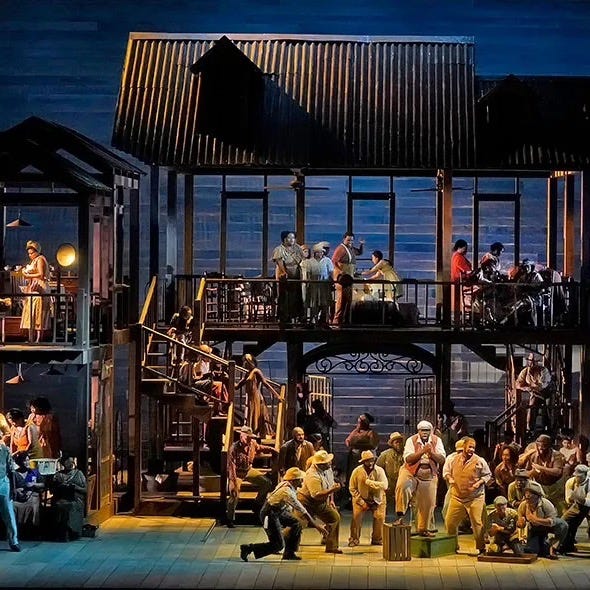
The reviews were mixed. Some critics found the opera too “high falutin.” Others were hoping for something more high falutin. Many criticized the fact that the story about black people was written by white people. Some objected to the portrayal of blacks as stereotypes who drank, gambled, used drugs and were often violent. Hall Johnson, an African American who studied Negro spirituals, felt the song depicted African Americans as unfaithful. On the other hand, many felt it gave blacks opportunities they had never had before to bring their history into the limelight.
Along the way, many African American performers refused to join any production of the opera.
Grace Bumbry, the black opera star who portrayed Bess in the 1985 Metropolitan Opera revival once said, “I resented the role at first possibly because I really didn’t know the score, and I think because of the racial aspect. I thought it beneath me. I felt I had worked far too hard and that we had come too far to regress to 1935. My way of dealing with it was to say that it was a piece of Americana, of American history.”
Ira was edged out of writing the lyrics for the most famous Porgy and Bess song, “Summertime,” but he made up for it with the words to “It Ain’t Necessarily So” which became almost as popular as “Summertime.”
Sung by the drug dealer, con man at a picnic on Kittawah Island near Charleston who is attempting to divert the police, Sportin’ Life is preaching a sermon to members of the community and is questioning all they have been taught and learned and believed to be so. He chides, even taunts the most reverent and traditionally minded folks on Catfish Row about some familiar but not so credible stories in the Bible and sings: “Da tings that you’re lible to read in the Bible, it ain’t necessarily so.” Then he proceeds to expound on his theory in clever rhymes about David and Goliath, Jonah and the Whale, Methusaleh, and Moses.
Methus’lah Lived Nine Hundred Years,
Methus’lah Lived Nine Hundred Years,
But Who Calls Dat Livin’
When No Gal’ll Give In
To No Man What’s Nine Hundred Years?
I’m sure my introduction to Biblical studies was from this song. It was much more entertaining than the version I learned in my religious Sunday School class.
George once said, “I think many of my themes are Jewish in feeling, although they are purely American in style.” Musicologists often point out similarities between Jewish liturgical themes and George’s compositions. One frequently cited example is the bridge between the stories in “It Ain’t Necessarily So” that bears a strong resemblance to the Jewish chants that open the reading of the Torah scrolls.
Many objected to Ira’s irreverence, but in the long run have come to believe that he’s just teasing people about what to accept and reject, a trait that he lovingly attributes to the history of his Jewish heritage.
Of the many productions of Porgy and Bess that have occurred over the years, one influence that stands out occurred during World War II. In 1943, the opera was produced in Copenhagen, Denmark at the Royal Danish Opera House, the first production of an American opera in Europe. Eventually the production was shut down because of Nazi pressure, but the Danish resistance often played “It Ain’t Necessarily So” on the radio as a sort of underground message to the enemy.
Unfortunately, two years after the debut of Porgy and Bess, George died of a brain tumor. He never saw the lasting impact that the opera has had. He was only 37.
In 1959, fourteen years after its Broadway debut Porgy and Bess the movie was made starring Sidney Poitier and Dorothy Dandridge with Sammy Davis, Jr. in the role of Sportin’ Life. Harry Belafonte refused to be a part of the movie. Sidney Poitier reluctantly played the role of Porgy because he was under contract.
Through its eighty-year history, there have been many recordings of “It Ain’t Necessarily So” as well as many other songs from Porgy and Bess. Ella Fitzgerald, Louis Armstrong, Miles Davis, Sting, Cher, and the Chicago Symphony Orchestra have all lent their interpretations to the song.
There have been hundreds of productions of Porgy and Bess throughout the country and the world. In the fifties the United States State Department sent a production on a world tour that included a presentation at the renowned La Scala Opera House in Milan, Italy. Among the myriads of others are the 2012 Broadway revival co-directed by African American Pulitzer Prize-winner Suzan Lori-Parks and that starred the Broadway diva Audra MacDonald, and a 2020 performance by the Philadelphia Symphony conducted by Marin Alsop.
Today most everyone would agree that Porgy and Bess is considered a national treasure and that the opera is more about human values and connection than it is about categorizing one race in one way, a message the Gershwin brothers subconsciously learned from their Jewish heritage. “It still endures and thrives and resonates with audiences of all backgrounds,” said one reviewer.
“Maybe,” said one critic, “the Gershwins, creators of quintessentially American music could stay out of the shul (Hebrew for temple) but the shul stayed in the Gershwins.”
SOURCES:
Ira Gershwin: A Life in Words by Michael Owen. Review by Beth Dwoskin. Jewish Book Council. December 2024.
Funny, It Doesn’t Sound Jewish by Howard Pollack. Review by Jack Gottlieb. Autumn 2006. Jstor.org
“The Story Behind Gershwin’s Porgy and Bess.” By Susan Lewis. WRTI, PBS. August 2020.
“Life of a Song.” By David Honigman. Financial Times. 2023
“Sportin’ Life was right, but what about that tune?” By Roger Price. Forum on Fact, Fiction and Faith. Judaism and Science. 2011.
“Summertime for George Gershwin.” By David Zax. 2010. “After a thirty-year absence the controversial Porgy and Bess is returning to the Met Opera.” By Brian Katz. September 2019. Smithsonian Magazine.
“George and Ira Gershwin.” George Mason University. May 2018.
“A Sometime Thing: The History of Porgy and Bess as Complex as the History of Race in America.” By Francis Davis. Politico. June 2012.
“Taking the Stage.” Charleston City Magazine. July 2010
As always, enjoy your writing, Mimi!
What a delightful and enlightening article. I have always enjoyed the Gershwin Brothrs' music.
Thank you, Mimi.
Jill