
FIDDLER FASHIONS AND BEYOND

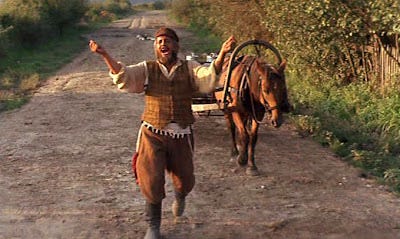
My introduction to the Orthodox Jews came when I went to see the 1964 hit Broadway production of the musical Fiddler on the Roof. For the first time I learned about a Jewish family in a small Russian village (shtetl) at the beginning of the twentieth century. The family was very different from my family in Skokie, Illinois, and yet we were both Jewish.
Recently I revisited the film that was made from the musical in 1970. Besides always enjoying the story and the music, what caught my eye was the dress of Tevye, the dairyman, Golde, his wife and their five daughters.
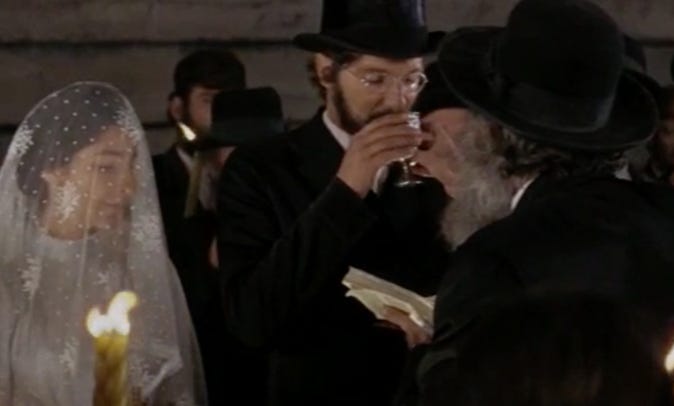
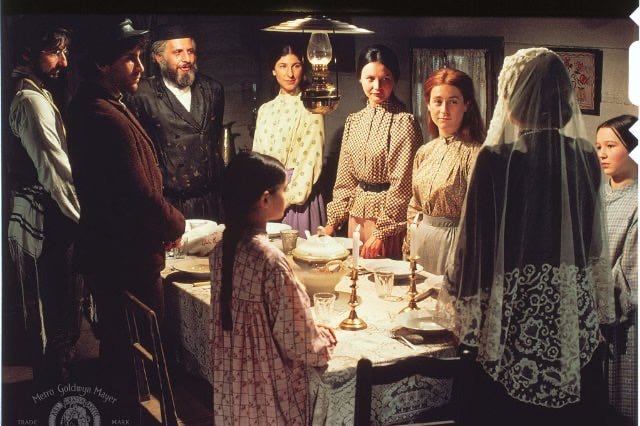
For work Tevye dressed in a peasant shirt, dark pantaloons, a plaid vest, and he wore a newsboy cap. Hanging from the back of his waist was a four cornered piece of cloth with strands of blue and black and outlined with fringes, a garment also worn by all of the men in his village, sort of a version of the tallis shawl we see observant Jews wearing today. Tevye’s wife wore a kerchief to cover her hair, a long dress and an apron. Her five daughters and the other women in the village also wore long dresses and kerchiefs. When Tevye’s daughter Tzeitel married Model the tailor, all the men exchanged their work clothes for black hats and black coats and pants, and the women wore wigs and long dresses that were made of finer materials like satin and silk.
I had no idea how these choices had come to be, or if they were, in fact, accurate. Beyond that, I wondered why today the dress of religious Jews is also distinct but very different from those of the characters in Tevye’s family.
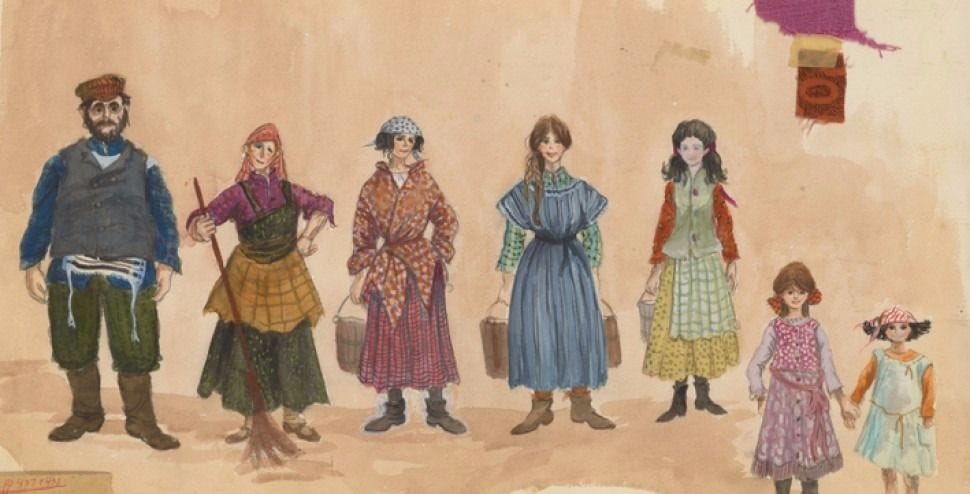
In the introduction to Fiddler on the Roof, Tevye relates the style of the villagers to “Tradition” and says that is how the villagers “keep their balance.”
“We have traditions for everything... how to sleep, how to eat, how to work, how to wear clothes. This shows our constant devotion to God…..
He asks rhetorically, “how did these traditions get started,” and then he responds, “I don’t know but it’s a tradition.”
Jewish dress has changed through the past two thousand years and, in a sense, tells us much about the Jews’ history and culture as well. Sometimes Jews have dressed distinctly from what they considered to be the “outsiders.” Sometimes the “outsiders” have demanded that Jews must dress as they decree. It’s very complicated, as most of us know, and not always factual, but it does explain the many variations that have been practiced since the beginning.
Some of the choices have been based on Jewish law, but mostly they have come about because of changes in customs.
The general doctrine for the Jewish dress code comes from the Jewish laws as defined in the Five Books of Moses, the Mishnah (oral history), the Talmud (written interpretations) and the rabbinic texts that have followed. For example, the mention of the four cornered garment, known now as a tallis or a prayer shawl, appears in the book of Numbers when G-d says to Moses: “Speak to the children of Israel and bid them affix fringes to the corners of their garments…that you may look upon them and remember all the commandments of the Lord.” And in Deuteronomy: “Make yourself tassels on the four corners of your cloak with which you cover yourself.”
Most of the further instruction comes from the rabbinical interpretations. The general concept of modesty and dignity in dress is only inferred. For example, one interpretation cites the Biblical section where a woman unbraids and loosens her hair that is described as adulterous and the rabbis list rules to counter her voluptuous tendencies by requiring women to wear head coverings. Although in the Old Testament, head coverings for men refer more to the high priests than to the commoners, in one part of the Talmud, the rabbis specify that men should not walk more than “four cubits” (six and a half feet) before needing to cover one’s head. Men growing payus (side curls) is referenced in the book of Leviticus in the Old Testament and then further interpreted in the 13th century by the Jewish philosopher Maimonides. The implication is that Jewish men should be differentiated from clean shaven “outsiders.”
The customs for dressing that have followed come about often because of where Jews were living and how they were either accepted or rejected. According to Olga Goldberg Mulkiewicz, in her, article “Dress,” Jewish dress was not standardized across Eastern Europe. “The differences underscored the social and material status of Jews, showed regional variations, and, in the nineteenth century, could indicate associations with Hasidic (Orthodox Jewish) groups. Individual rebbes imposed specific elements of clothing on their followers, sometimes dictating types of head coverings or shoe styles.”
There were many historic periods prior to the 18th century when Jews were living in different lands and were required to follow various laws. In the sixteenth century Polish legislation followed the Western European practice that Jews should wear distinctive clothing. Men were required to wear yellow hats or berets and women to wear yellow headscarves. Russians in the nineteenth century wrote laws compelling Jews to abandon distinctive attire.
In Fiddler on the Roof the choice of the materials like silk and satin and the patterns like calico and plaid, mirror the styles of early twentieth century Eastern Europe. Regardless, Tevye and his fellow villagers still maintain their identity by wearing what at that time seems to be traditional Jewish clothing.
When the Reform Jewish movement began in the 18th century and suggested that Jews abandon any religious garb that differentiated them, rabbis in the Orthodox Jewish movement countered this belief and advocated for the need of Jews to distinguish themselves by the clothing they wore. Jewish scholars argued that in the past Jews wanted to dress differently to stand out from their gentile neighbors. One source mentions that maybe the Jewish slaves were successful in exiting Egypt because they could be easily identified by their dress. Another source mentions how the warrior Judah Maccabbee in Greek times before the first century CE insisted that his militia not imitate the attire of their neighbors.
There have been all kinds of answers to those rabbis’ concerns that are mirrored in the modern Orthodox movements. To distinguish themselves Hasidic Jews and the more Ultra-Orthodox Heredi Jews often wear shtreimels or fur hats inspired by the hats worn by Polish nobility in the 18th century, the more Modern Orthodox Jews suggest wearing plain white shirts, black suits and fedoras as their uniforms (They call it “Torah true”), and women have gone back to wearing long dresses and covering their heads after they marry but often take some liberties by adorning their garments or wearing attractive wigs.
The conflict continues today between the need to identify one’s Jewish affiliation by what one wears and believes and the need to assimilate with the country in which Jews are living.
The fact that we are all residing in a modern era where consumerism is easy and manufactured clothing is faster and more diverse has increased the ability of Orthodox Jews to combine the religious aspects of conforming to past laws and customs in a way that allows creativity and yet maintains the ability to separate their groups from the norm. Thus, one can choose to wear a a yarmulke (Yiddish for a traditional skull cap and known in Hebrew as a kippah) that is crocheted or made of suede or embroidered like the Jewish Sephardic style. The choices are countless.
For me, I’m still dressing like the diasporic country in which I live, but I am now more mindful of the need for all of us to respect the choices one makes that are different than mine. In Fiddler on the Roof Tevye’s family wears traditional clothing but there are glimpses of the changes that may be coming including the need for adapting to the clothes that should be worn.
To be continued…..
I invite you to order and read my new book CITIZEN MOM: AN AMERICAN STORY about my German Jewish mother’s journey to America and her life after she arrived.

SOURCES:
“The Fiddler on the Roof Movie’s Costume Study.” Edelweiss Patterns. March 2013
“Dress.” By Olga Goldberg Mulkiewicz. The YIVO Encyclopedia of Jews in Eastern Europe.
“The Shtetl Jew: Relic or Role Model.” By Aron Moss. Chabad.org
“Dressing for change: Jews, clothing and modernization.” By Dr. Jonathan Kaplan. Sidney Jewish Museum. 2023.
“The Enduring Trajectory of Jewish Fashion.” By Em Seely-Katz. Longnow.org. December 2023.
“The Meaning Behind Different Jewish Hats.” MyJewishlearning.com.
“Jewish religious clothing.” Wikipedia.
“What is Orthodox Judaism?” By Howard Lupovitch. The Detroit Jewish News. June 2013.
“Religious Dress.” Britannica.com.
“Prayer Shawls for Tryon Little Theater’s Fiddler on the Roof.” Tryon Daily Bulletin. January 2014.
“See the Original Sketches for Fiddler on the Roof. By PJ Griser. The Forward. September 2018.
“Why Do Many Hasic Jews wear Shtreimels (Fur Hats).” By Yehuda Sharpin. Chabad.org.
“Fiddler on the Roof Costumes: Fast Track Guide to Creating Iconic Fiddler on the Roof Characters.” By Sarah Thompson. Coohom.com. September 2025.
“Costuming: Dressing the Characters of Anatevka.” By Molly Roy. Slidell Little Theater. August 2024.
“Jewish Clothing.” My Jewish Learning.
“Jewish Dress.” By Yehuda Leib Schapiro. Chabad.org.
“Jewish Head Coverings: A Blessing on Your Head.” The Association for Jewish Studies. Podcast with Eric Silverman and Amy K. Mulligan.
“I Spend a Day with Hassidic Jews in New York.” Youtube. Drew Binsky. https://www.facebook.com/watch/?v=1405821250845088
“Jewish Practices and Rituals: Covering of the Head.” Edited by Judith R. Baskin. Jewishvirtuallibrary.org.
.
Interesting!